Compare Farming Drones: Pick the Right One Fast
Published: 8 Aug 2025
When choosing which type of drone is used for agriculture, it’s easy to get overwhelmed. Fixed-wing drones cover more ground, while multi-rotor drones offer better control and hovering. Spraying drones can handle chemical applications, but mapping drones give you a bird’s-eye view of your crop health. So, which one’s better? The answer depends on your farm, your crops, and your goals. In this piece, we’ll compare the top drone types used in agriculture—looking at their strengths, weaknesses, and the kinds of tasks they’re best at.
Fixed-Wing Drones: Best for Large Farms
Fixed-wing drones are shaped like small airplanes. They don’t hover like quadcopters, they glide forward through the air. These drones are built for covering long distances fast, which makes them ideal for big farms.
Covers More Ground :
Fixed-wing drones can fly longer and farther than most multi-rotor drones. This helps farmers scan large fields without needing to recharge often.
Great for Mapping :
Their stable flight path allows for consistent, high-quality aerial images. These images are useful for creating field maps, crop health reports, and surveying land.
Needs Open Space to Launch :
Unlike quadcopters, fixed-wing drones usually need a runway or a launch system like a catapult. This can be tricky on small or crowded farms.
Cost and Control :
They tend to cost more and are harder to maneuver in tight spaces. They can’t hover, so they’re not useful for tasks that need still, close-up views.
Multi-Rotor Drones: Good for Small Areas and Precision
Multi-rotor drones like quadcopters—are the most common type used on farms. They have multiple propellers and can hover in one spot, making them perfect for close-up tasks and tight areas.
Perfect for Spot Checks :
These drones are perfect for checking plant health, spotting pest damage, or inspecting specific parts of a field without walking through crops.
Easy to Fly and Control :
Most multi-rotor drones are beginner-friendly. You can launch them straight up from the ground, and they hover easily, which makes them great for first-time users.
Short Flight Time :
Because they use more energy to stay in the air, they have shorter battery life. They work best for small plots or short flights, not large area surveys.
Limited Coverage Range :
Multi-rotor drones can’t cover as much ground as fixed-wing types. If your farm is large, you might need several flights to scan everything.
Spraying Drones
Spraying drones are built to carry and release liquid chemicals like pesticides, fertilizers, or herbicides. They fly low over crops and spray with precision, helping farmers treat specific areas without wasting resources.
Efficient Chemical Spraying :
These drones use built-in tanks and nozzles to spray only where needed. This means fewer chemicals used and less exposure to humans or nearby crops.
Reduces Crop Damage :
Unlike tractors or workers walking through fields, drones don’t crush plants. They can fly over wet or uneven ground without leaving a mark.
Needs Regular Refilling :
Because tanks are small, spraying drones can’t cover huge areas in one go. You’ll need to land, refill, and relaunch multiple times for bigger fields.
Requires Setup and Calibration :
To spray the right amount, you will need to adjust flow rates, flight height, and paths. It takes a little practice to get it just right.
Mapping And Imaging Drones
These drones come equipped with advanced cameras and sensors—like RGB, multispectral, or thermal imaging. They don’t spray or carry loads, but they give farmers a bird’s-eye view of their crops to make smarter decisions.
Track Crop Health from Above :
These drones scan fields to detect early signs of crop stress, diseases, or nutrient issues—things you can’t always spot from the ground.
Catch Water or Pest Problems Early :
Multispectral and thermal sensors help identify dry patches, water stress, and pest damage before they spread, saving both time and yield.
Create Accurate Field Maps :
With the right software, these drones turn images into detailed 2D and 3D maps. Farmers use them for planning irrigation, planting, or applying fertilizer precisely.
Needs Software and Know-How :
The data is valuable, but you will need apps or mapping tools to read it properly. These drones don’t do the spraying, so they’re for monitoring only.
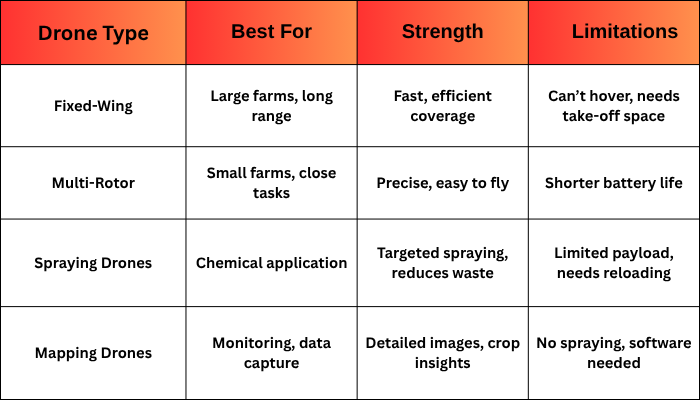
Comparison Table: Quick Overview of Drone Types
Find the Drone That Fits Your Farm
Not every drone fits every farm. The best one depends on what you need it to do, how much land you manage, and how comfortable you are with tech.
Know Your Main Purpose :
Are you spraying chemicals, checking crop health, or mapping your land? A drone for farm use should match your primary goal. Spraying drones help with application tasks, while mapping drones focus on monitoring and analysis.
Think About Farm Size and Layout :
For large, open fields, fixed-wing drones are efficient. For smaller or irregular-shaped plots, multi-rotor drones give better control and flexibility.
Factor in Budget and Skills :
Spraying and mapping drones cost more and need some training to use effectively. If you’re new to drones, start with a basic multi-rotor model and upgrade as you go.
Check for Local Rules and Support :
Look into local drone regulations, licensing, and service support. Buying a high-tech drone won’t help if it’s hard to maintain or not allowed to fly in your area.
Conclusion
Now you know the main types of drones used in agriculture—fixed-wing for large areas, multi-rotor for close-up tasks, spraying drones for chemical application, and mapping drones for crop insights. Each has a different job, and no single drone does it all.
Don’t fall for the flashiest features or the latest hype. Focus on what your farm actually needs. Start small—try one drone that fits your top priority. Once you get comfortable and see results, you can always scale up or add more advanced tools.