How Drone Range Impacts Your Farming Results & Reach
Published: 9 Aug 2025
You have probably watched drones zip across fields and wondered—how far can agricultural drones really fly? It’s easy to assume they can cover endless ground, but the truth depends on the drone you are using. Battery life, signal range, and weather all play a part. Some drones max out at 2 km, while advanced ones go beyond 10 km. If you are trying to map a large farm or spray crops over wide areas, knowing your drone’s flight range matters. Before you buy, ask yourself: is the drone’s range enough for your land? Let’s break it down in simple terms.
How Drone Range Affects Your Farm’s Efficiency
A drone’s flight range is not just a technical number—it directly affects how much ground you can cover, how fast you can work, and how often you need to stop. How longer-range agricultural drones can make your farming more efficient:
Cover More Land with Fewer Flights
Less downtime: A long-range drone can fly across big fields without needing to return for a recharge every 10 minutes.
Fewer interruptions: You spend less time planning multiple short trips or changing batteries.
More work done in one go: Whether you’re spraying or mapping, you can do more with fewer flights.
Save Time and Fuel
Less manual effort: You don’t need to drive across fields to monitor crops or inspect areas your drone handles it.
Fewer support trips: No need to carry extra batteries or move your base station around the farm.
Faster field coverage: Long-range drones move quickly and efficiently, reducing the hours spent on each task.
Better Crop Monitoring
Consistent scanning: A longer flight range means the drone can cover a full field in one continuous sweep, giving you uniform data.
No patchy results: Short-range drones often miss sections, especially in large fields.
Better insights, faster decisions: With clear, full-field images or sensor data, you can act sooner and more accurately.
Increased Productivity Across Seasons
Do more in less time: During peak farming seasons, time matters. Longer drone range helps you keep up with demand.
Plan smarter: Fewer flights and battery changes mean you can schedule and finish work faster.
Improve ROI: More efficient drone use means you get more value out of your investment.
Key Factors That Affect Flight Range
How far an agricultural drone can fly doesn’t depend on just one thing. It’s a mix of power, weight, weather, and where you fly. Here are the main factors that control your drone’s flight range:
1. Battery Life
More power, more distance: Bigger or stronger batteries let drones fly longer before needing a recharge.
Wind and load drain power: Flying in strong wind or carrying a heavy payload uses up battery faster.
Cold weather cuts time: In colder conditions, batteries don’t last as long and the drone may return sooner.
2. Signal Strength
Controller vs GPS: Drones use remote control signals or GPS links. Both have limits. When the signal weakens, the drone can lose control.
Loss of signal: If the drone flies too far, it may stop responding or turn back.
Boosters help: Signal boosters or repeaters can help if you need to fly farther on open land.
3. Payload Weight
Every gram counts: The more tools or liquid you attach (like cameras or sprayers), the shorter the flight.
Heavier = slower and shorter: More weight pulls more battery power and reduces both speed and range.
Balance matters: Carry only what you need to get the best distance and stable flight.
4. Weather Conditions
Wind slows things down: Flying against strong wind drains battery faster and makes the drone work harder.
Heat and rain hurt performance: Very hot or wet weather can mess with flight systems and shorten distance.
Pick clear days: For best results, fly on calm, dry, and clear-weather days.
5. Terrain and Obstructions
Obstacles block signals: Trees, hills, and buildings can interrupt the drone’s signal and limit how far it can go.
Flat fields work best: Open farmland with no big barriers is perfect for long-range flying.
Stay in line of sight: Keep the drone visible and avoid risky paths behind obstacles.
How Far Do Entry-Level Agricultural Drones Fly
Entry-level agricultural drones are designed for small-scale work and learning. They don’t fly as far as high-end models, but they are reliable and easy to use for basic farm tasks.
1. Average Range
1 to 3 kilometers: Most beginner drones can fly between 1 to 3 km before needing to return. This is enough for small farms and short flights.
Quick recharge needed: These drones usually run on smaller batteries, so they need recharging more often.
2. Real Examples
DJI Agras T10: A solid entry-level drone built for light spraying and easy handling.
Parrot Bluegrass: Known for basic crop health monitoring and good image quality. Both are ideal for first-time users.
3. Best for Simple Tasks
Spot spraying and checks: These drones are great for spraying a small area, checking crop health, or flying over a section of your field.
Easy learning curve: Perfect for farmers who are new to drone use and want to build confidence.
4. Affordable and Accessible
Lower cost: Entry-level drones are budget-friendly and still get the job done.
Less setup needed: Easy to operate without needing advanced training or complex software.
How Far Do High-End Agricultural Drones Fly
High-end agricultural drones are built for serious work. They fly much farther than entry-level models and are packed with advanced features. These drones are perfect for covering large farms, handling heavy tasks, and saving time during busy seasons.
1. Average Range
5 to 10+ kilometers: These drones can easily cover long distances without stopping. They’re made for big farms where one flight needs to cover a lot of ground.
Longer flight time: Bigger batteries and smarter systems keep them in the air longer.
2. Real Examples
DJI Agras T40: A powerful spraying drone that can handle large fields with precision.
SenseFly eBee X: Known for long-range mapping and data collection, often used in professional surveying and crop analysis.
3. Built for Range
Stronger batteries: High-capacity batteries give these drones more power and time in the air.
Smarter systems: Advanced flight planning, GPS, and sensors help them fly efficiently over large areas.
Reliable return: These drones can return safely even from long distances if the battery runs low or signal drops.
4. Best for Large Tasks
Full-field spraying: Cover entire fields without stopping for recharges.
Precision mapping: Capture high-quality data across wide land areas in one flight.
Time-saving: Finish jobs faster, with fewer takeoffs and landings.
Matching Drone Range to Farm Size
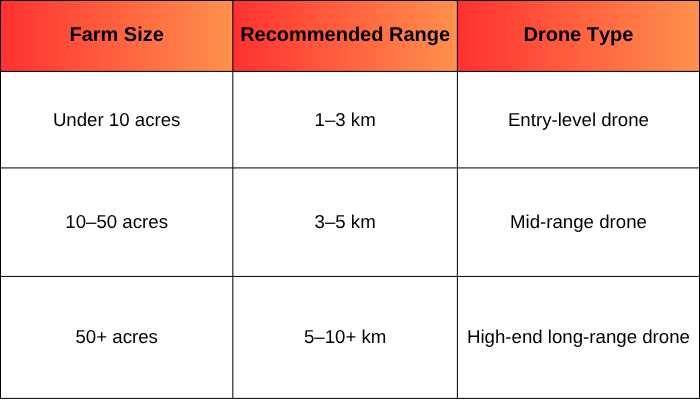
Not all farms need the same kind of drone. The size of your land plays a big role in what flight range you need. Simple way to match drone range to your farm’s size and avoid overspending or underperforming. When picking a drone for your farm, don’t just look at the price tag or brand name. Check how far it can fly, what kind of work it can do, and whether it suits the size of your land. Choosing the wrong one could cost you more in the long run.
1. Small Farms (Under 10 Acres)
Entry-level drones work well: Most beginner drones can cover this size easily with a single flight.
Best for quick jobs: Use them for checking crops, spraying small plots, or testing drone features.
2. Medium Farms (10–50 Acres)
Mid-range drones are ideal: Look for drones with 3–5 km range to avoid frequent recharges.
Efficient coverage: These drones can handle basic spraying, mapping, and crop scouting in one or two flights.
3. Large Farms (50+ Acres)
Go long-range: Choose drones with 5–10+ km range to save time and effort.
Plan smarter: Use flight planning tools to split fields into zones and cover them efficiently.
4.Quick Tip Table
Legal and Safety Limits on How Far You Can Fly
Even if your drone can fly far, that doesn’t mean you’re always allowed to. Many countries have rules to keep drones flying safe—for you, your drone, and others. Before you launch, it’s important to know the basic legal and safety limits.
1. Line of Sight
Stay within view: Most countries require that you always keep your drone in sight, also called Visual Line of Sight (VLOS).
No blind flights: If you can’t see your drone, you’re likely breaking the rules—even with a camera view.
2. Range Limits
Follow local laws: Some places limit how far a drone can fly without a special license or permit.
Check before flying: Always check your country’s drone rules before planning long-range flights.
3. Safe Flying Tips
Avoid risky areas: Stay away from airports, crowded places, power lines, and restricted zones.
Monitor battery and weather: Know when to stop and always fly in safe conditions to prevent crashes.
4. Use RTH Feature
Return-to-home (RTH): This feature makes the drone come back automatically if it loses signal or battery runs low.
Set it up right: Make sure your drone’s RTH height and location are set before each flight.
How to Choose the Right Drone Based on Flight Range
Buying a drone is not just about picking the one that flies the farthest. You need to match the drone’s range with your farm’s size, your daily tasks, and your long-term plans.
1. Know Your Needs
Farm size and tasks: Are you spraying crops, mapping fields, or just monitoring plant health? Small farms need less range. Large farms and spraying jobs need longer flights.
Start with purpose: Choose a drone that fits what you’ll actually use it for.
2. Check the Specs
Look at range and battery: Make sure the drone’s official specs include flight range, battery time, and max payload.
Don’t guess: Always compare numbers across models to find the best fit.
3. Read Real Reviews
Learn from others: Check what other farmers say about the drone’s real-world performance—not just the marketing claims.
Watch out for issues: Reviews often reveal things like signal problems, weak battery life, or poor build quality.
4. Think Long-Term
Plan for growth: If your farm is expanding or your tasks are changing, pick a drone that can keep up.
Upgrades and support: Choose brands with good service, spare parts, and upgrade options to avoid future headaches.
Final Thoughts
Drone range isn’t just a tech spec, it decides how much of your farm you can actually cover in one flight. If the range is too short, you will waste time with recharges. If it’s too long for your needs, you might overspend.
The smart move? Match the drone’s range to your farm size and what you plan to do—spraying, mapping, or monitoring.