AI Mapping and Navigation for Next-Gen Indoor Drones
Published: 30 Aug 2025
Did you know drones can now fly indoors without crashing into walls, furniture, or other obstacles? Thanks to indoor drone navigation with AI, this is no longer a challenge. Advanced sensors and AI algorithms allow drones to detect surroundings, plan routes in real time, and adjust their movements automatically. This innovation is opening up applications in warehouse management, indoor mapping, security, and even home entertainment. What used to require highly skilled pilots is now handled by intelligent machines, making indoor drone operations safer, faster, and more efficient than ever before. AI is literally teaching drones to think for themselves.
How Indoor Drone Navigation Works
Flying a drone indoors is a whole different game than flying one outside. Indoors, there’s no GPS signal, limited space, and more obstacles to avoid. This is where artificial intelligence and advanced sensors step in, making it possible for drones to fly smoothly without hitting walls or furniture.
Understanding Indoor Flight Challenges
Flying indoors is harder because the environment is unpredictable and space is limited.
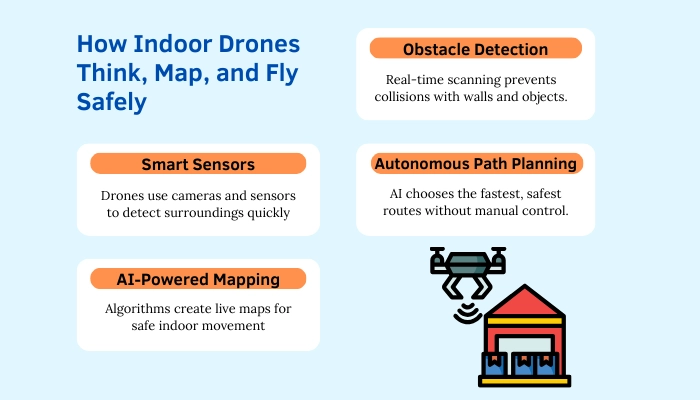
No GPS Support: Indoors, drones can’t rely on satellite-based positioning like they do outdoors. Instead of a traditional drone GPS module, they depend on advanced vision systems, sensors, and AI mapping to figure out their exact location.
Tight and Cluttered Spaces: Furniture, narrow hallways, and shelves create tricky paths, requiring precise movement.
Low Light or Poor Visibility: Many indoor areas don’t have great lighting, making it hard for cameras to see clearly.
Moving Obstacles: People, pets, or machinery can suddenly block paths, adding even more challenges.
The Role of Sensors
Drones rely on multiple sensors to see their surroundings and avoid crashes.
Cameras: Capture real-time images so drones can recognize obstacles and find safe paths.
LiDAR Sensors: Use laser beams to measure distances and build a 3D map of the area for accurate navigation.
Ultrasonic Sensors: Emit sound waves to detect nearby objects, helping drones fly close to walls or ceilings without hitting them.
Infrared Sensors: Detect heat patterns and objects even in dark or low-light environments.
AI in Action
Artificial intelligence is the brain that helps AI-guided drones make smart decisions instantly.
Real-Time Decision-Making: AI analyzes sensor data in milliseconds, allowing drones to dodge obstacles quickly.
Path Planning: Algorithms calculate the safest and most efficient route to follow indoors.
Adaptive Movements: AI adjusts flight speed, height, and direction on the fly, making drones responsive to sudden changes.
Learning From Experience: With every flight, AI remembers the environment, improving navigation accuracy over time.
Key Technologies Behind AI Navigation
AI-powered drones rely on advanced tech to fly smoothly indoors. These technologies allow drones to see, think, and navigate without human control.
Computer Vision
Computer vision helps drones see their surroundings and understand what’s around them.
Object Detection: Cameras and sensors capture images, and AI identifies walls, furniture, and other objects.
Depth Perception: Drones estimate distance from objects, helping them avoid collisions in tight areas.
Visual Tracking: Drones can follow moving objects or people, making them useful for security or filming indoors.
Environmental Awareness: They build a picture of the space in real time, even in changing lighting conditions.
Machine Learning
Machine learning trains drones to recognize patterns and respond intelligently.
Learning From Data: Drones process thousands of flight hours and sensor readings to improve performance.
Pattern Recognition: They learn to spot common indoor obstacles like doors, shelves, and cables.
Smarter Decisions: Machine learning lets drones choose the best paths without needing manual input.
Continuous Improvement: Every flight helps drones learn more, making them safer and more accurate.
SLAM (Simultaneous Localization and Mapping)
SLAM lets drones know where they are and create maps at the same time.
Real-Time Mapping: Drones scan rooms and build a 3D map as they fly.
Position Awareness: SLAM shows the drone its exact location, even without GPS signals.
Navigation in Unknown Spaces: Perfect for new buildings, warehouses, or rooms the drone hasn’t seen before.
Smarter Routes: SLAM helps AI find efficient paths and avoid retracing unnecessary routes.
How Drones Transform Logistics
Drones are changing how businesses manage warehouses and deliveries. They make work faster, safer, and more accurate by taking over tasks that used to take hours.
Smart Warehouses : Drones fly through aisles and scan barcodes on shelves. They update stock records in real time, helping staff find items faster and avoid stock mistakes.
Indoor Package Delivery : Instead of workers walking long distances, drones carry parts and products across large facilities. This saves time and keeps operations running smoothly.
Real-Time Data Collection : Drones can quickly check inventory and send live updates to warehouse systems. Teams always know what’s in stock without doing slow manual counts.
Indoor Mapping and Surveying
Drones make it easier to study and plan indoor spaces by capturing accurate data quickly. They’re a safer, faster alternative to manual surveys.
3D Mapping of Buildings : Drones use cameras and sensors to create detailed 3D layouts of rooms, hallways, and entire buildings. This helps businesses plan space and track changes over time.
Facility Inspections : Drones can safely inspect ceilings, beams, and hard-to-reach areas. They spot damage or safety risks without putting workers in danger.
Emergency Planning : By mapping exits and escape routes, drones help teams design better safety plans. They provide a clear view of the best paths to take in case of emergencies.
Home and Entertainment Uses
Drones are not just for work; they’re becoming fun and helpful tools at home too.
Indoor Filming and Photography : Drones can safely fly inside your home to record family events, parties, or creative videos. They give unique camera angles without needing big equipment.
Drone Games and Racing : Indoor drone racing and obstacle games are becoming popular hobbies. People build tracks at home or join clubs to test their flying skills.
Smart Home Monitoring : Drones can patrol inside your house, check on pets, or even make sure everything is safe when you’re not around.
Benefits You Can’t Ignore
Businesses are turning to drones because they save time, cut costs, and improve safety.
Increased Efficiency : Drones handle tasks like scanning inventory, delivering supplies, and transporting documents faster than people. This keeps warehouses, offices, and hospitals running smoothly.
Better Security : Automated drone patrols watch over buildings and parking areas. They can spot unusual activity, reducing the need for constant manual checks.
Cost Savings : By replacing repetitive manual work with automation, companies save money on labor and reduce costly mistakes over time.
Challenges and Things to Watch Out For
Drones are powerful tools, but they also come with challenges businesses need to plan for.
Battery Life Issues : Most drones can only fly for a short time before needing a recharge. This means frequent breaks, which can slow down work.
Sensor Limitations : Cameras and sensors may struggle in low light, narrow spaces, or areas with shiny surfaces. This can affect accuracy and safety.
Software Glitches : Like any tech, drones can face bugs or crashes. Regular updates and testing are key to keeping them reliable.
Maintenance and Keeping Your Drone Smart
Taking care of your drone helps it fly better, last longer, and stay safe to use.
Regular Software Updates : Updating your drone’s software keeps its AI features accurate and reliable. It also adds new safety tools and fixes bugs.
Sensor Cleaning and Calibration : Dust or misaligned sensors can ruin flight accuracy. Cleaning and calibrating them often ensures smooth flying and precise data.
Safe Storage and Charging : Store your drone in a cool, dry place and charge it properly. This keeps batteries healthy and prevents damage over time.
Conclusion
AI is completely changing how drones work indoors. What used to take skilled pilots is now handled by smart technology that can see, think, and react in real time. These drones are already making warehouses faster, mapping buildings more accurately, and even adding fun and safety to homes.
In the future, expect drones to play a bigger role in everyday life—delivering supplies in hospitals, patrolling offices at night, or filming events at home without crashing. With smarter AI and better sensors, drones will become a normal part of smart buildings, businesses, and entertainment spaces.